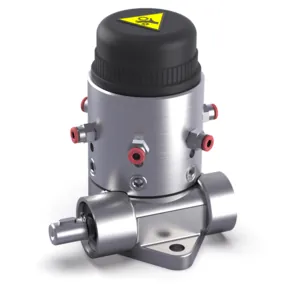
Pump PRM
The "PRM" is a high quality piston pump with multiple independent outputs. It is mechanically driven by a cam system and is ideal for use in automated industrial systems.
Technology
Technical data and selection
A multi-outlet pump saves the divider: instead of producing one flow and splitting it afterwards, it has a pumping element per lubrication point. Every outlet therefore delivers independently — a blocked line takes nothing away from the others, and changing the dose at one outlet does not shift the rest.
| Parameter | Value |
|---|---|
| Pumping system | 6 |
| Output per cycle | 0.015–0.06 cm³ |
| Outlets | max. 12 |
| Max. pump speed | 45 |
| Reduction ratios | 2.2:1 · 8:1 · 8.75:1 · 25:1 · 50:1 |
| Delivery / suction port | Ø 4 mm / Ø 8 mm |
| Viscosity | 15–1000 cSt |
| Storage temperature | −15…+90 °C |
| Part numbers | 0146200-000000 (PRM12B2.2S) · 0146204-000000 (PRM12B8.75S) |
Source: DropsA manufacturer data, retrieved 31 July 2026 – PRM. The figures in the respective datasheet are binding.
The reduction ratio is the actual design parameter
On a mechanically driven pump the dose is not set by a timer but by the reduction ratio. Five steps from 2.2:1 to 50:1 span a factor of more than 20 — and because the drive comes from the machine, the volume scales automatically with machine output. Running slower means less lubrication, which is exactly right when demand follows wear.
An output of 0.015 to 0.06 cm³ per cycle looks small, and it is. This order of magnitude is meant for oil on guideways, chains and sliding surfaces, where a continuous thin film is needed — not for bearings with a high individual demand. Twelve outlets at 0.06 cm³ come to 0.72 cm³ per cycle for the whole system.
A worked example
On a machine with eight points, a 25:1 reduction and a drive speed that yields 30 cycles per minute after the reduction, each outlet delivers roughly 0.9 cm³ per minute at 0.03 cm³ per cycle. Whether that fits is decided by the point's demand, not by the pump — the reduction is the adjusting screw, not the pump size.
The viscosity window of 15 to 1000 cSt applies at operating temperature. On a cold start an ISO VG 220 sits well above it and the pistons do not fill completely, so the actual dose in the first minutes is lower than calculated.
Looking for the right product?
We support you with selection, design and quotation – oil & grease, for every application.
Knowledge
Further content
- Progressive distributor – uniform distribution
- Dual-line systems – long distances & high viscosity
- Cycle sensors – monitoring lubrication cycles
- MAGNOM® filter – particle & magnetite separation
- Industrial oils – selection & application
- Troubleshooting the ZSA – checklist
- Central lubrication – basics & planning
- Contact & Offer – Individual advice