Range
Products at a glance2

Ultrasensor M18x1 general purpose
Versatile sensor in M18×1 housing – reliably detects positions and flow paths in oil and grease-based systems.
Ultrasensor DM/DMM
Compact DM/DMM sensor with high repeatability – ideal for tight installation spaces and fast cycle times.
Technology
Technical data and selection
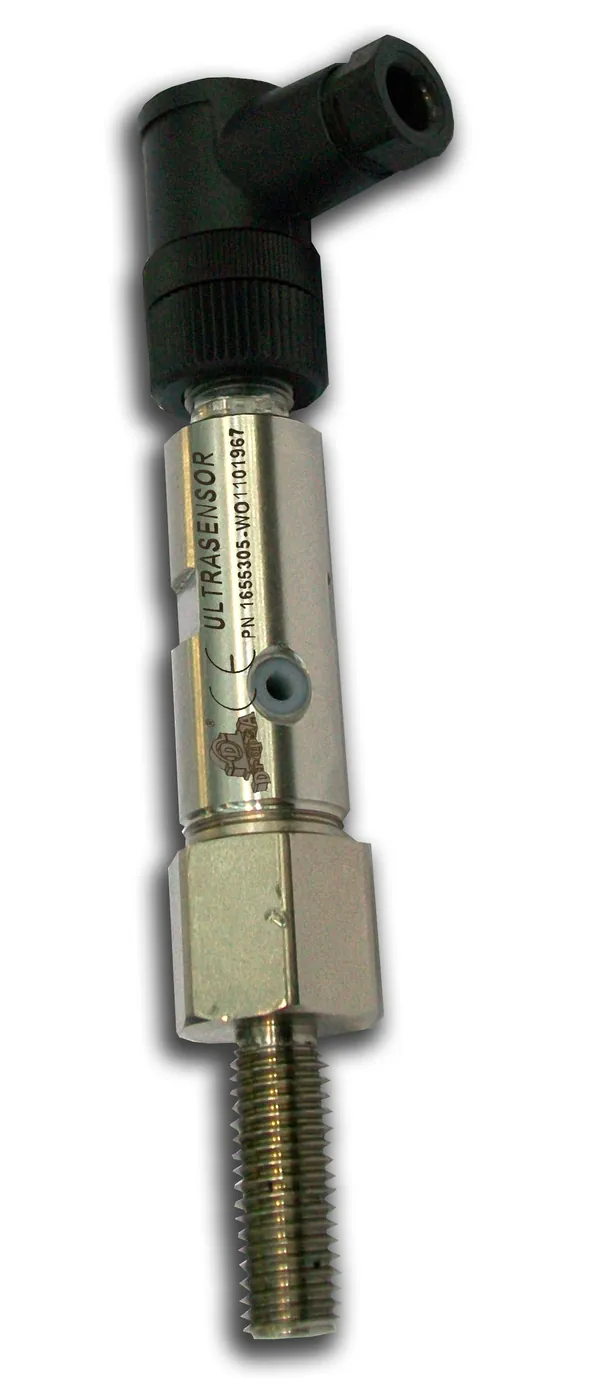
A cycle sensor answers the one question an automatic lubrication system cannot answer by itself: did the divider actually index? A running pump and a pressure reading do not prove that lubricant reached the point. Only feedback from the piston stroke inside the progressive divider turns lubrication into monitored lubrication.
| Parameter | Value |
|---|---|
| Supply voltage | 8–28 V DC |
| NPN output | 2 A, normally open |
| PNP output | 0.7 A, normally open |
| Operating temperature | −10…+60 °C |
| Protection | IP 67 |
| Connector | M12×1 |
| Max. cycle rate | 1000 cycles/min |
| Part numbers | 1655310 · 1655314 · 1655329 · 1655344 · 1655350 |
Source: DropsA manufacturer data, retrieved 31 July 2026 – Ultrasensor DM/DMM. The figures in the respective datasheet are binding.
Why the measuring principle matters
The Ultrasensor works on the Hall effect: it registers the change in magnetic flux produced by the moving piston inside the divider block. No opening into the pressure chamber is needed, there is no moving seal towards the sensor and no wear path that could become a leak at 400 bar system pressure. The sensor screws on from the outside.
The rating of 1000 cycles per minute is generous for lubrication — a progressive divider indexes on a scale of seconds to minutes depending on design. More relevant in practice is the 8 to 28 V DC range: the sensor runs on a 24 V plant supply and on a 12 V vehicle system alike, with no level converter.
NPN or PNP — the controller decides
Both versions are normally open but differ in load capacity: 2 A on the NPN output against 0.7 A on the PNP output. In Europe PLC inputs normally expect PNP signals; if a relay or indicator lamp is driven directly instead, the current decides. Both versions are short-circuit proof.
IP 67 means dust tight and protected against temporary immersion — for a sensor on a construction machine or in a wash-down zone that is the deciding figure. Our page on progressive dividers covers where monitoring sensibly attaches.
Looking for the right product?
We support you with selection, design and quotation – oil & grease, for every application.
Knowledge