Range
Products at a glance5
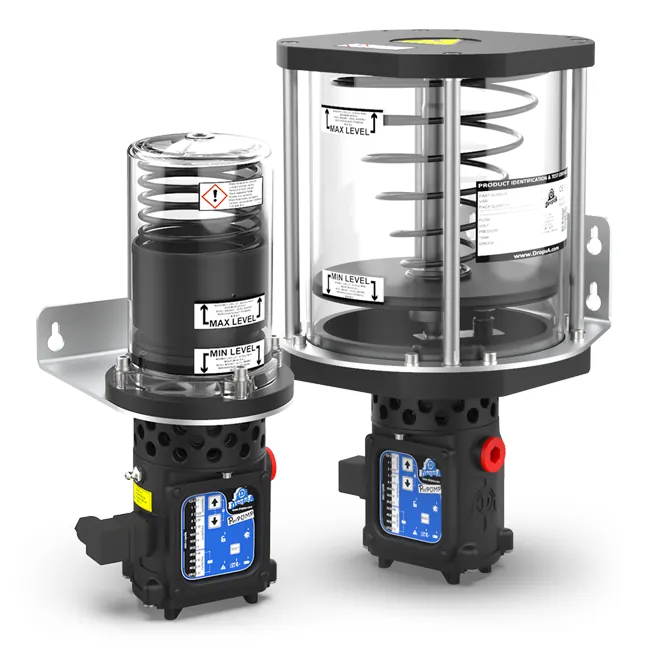
PoliPUMP FP
Compact lubricant pump with multiple outlets and follower plate
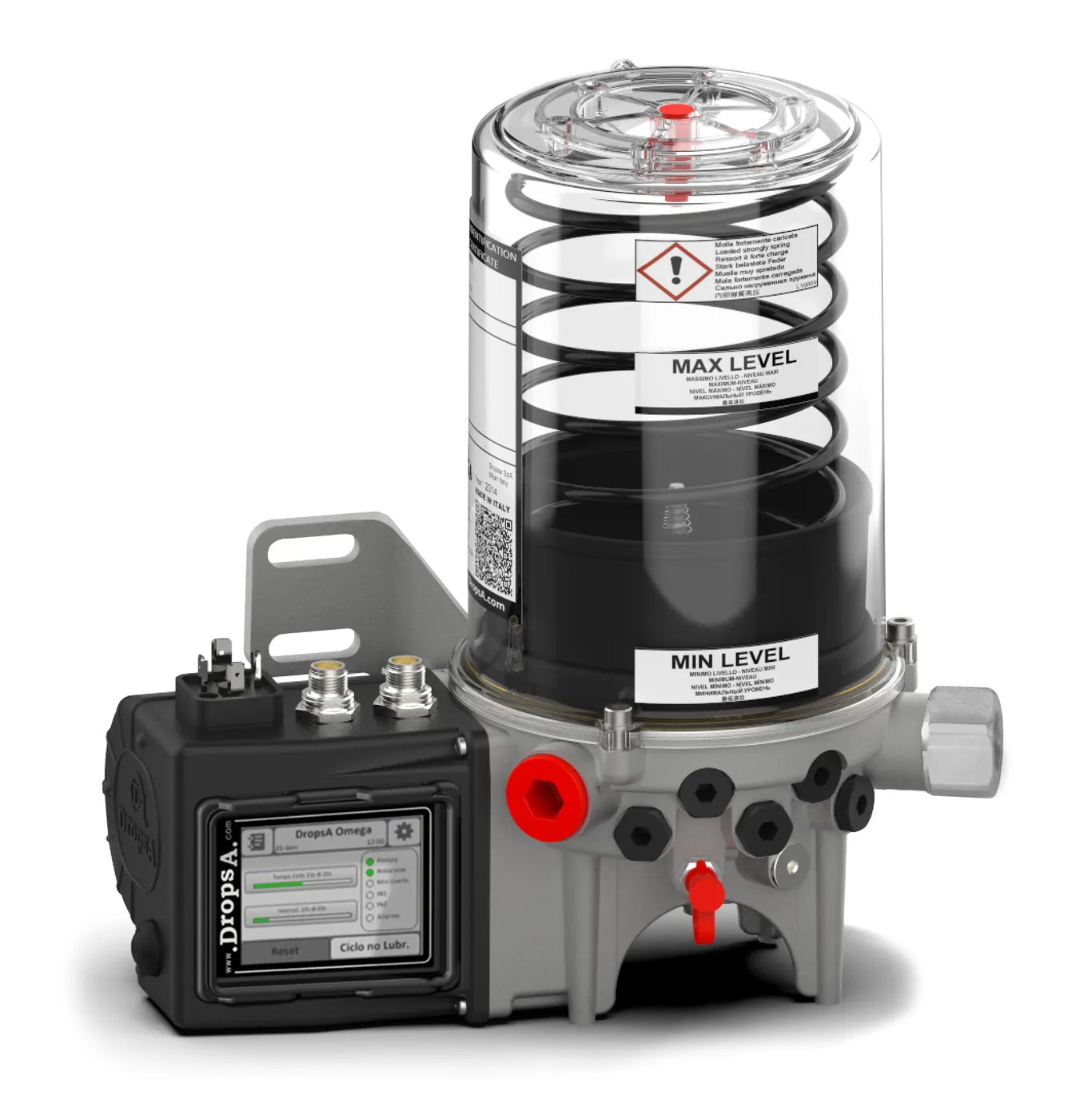
OMEGA pump
Big performance in a small pump
FEMTO pump
Versatile grease pump for multiline and progressive systems
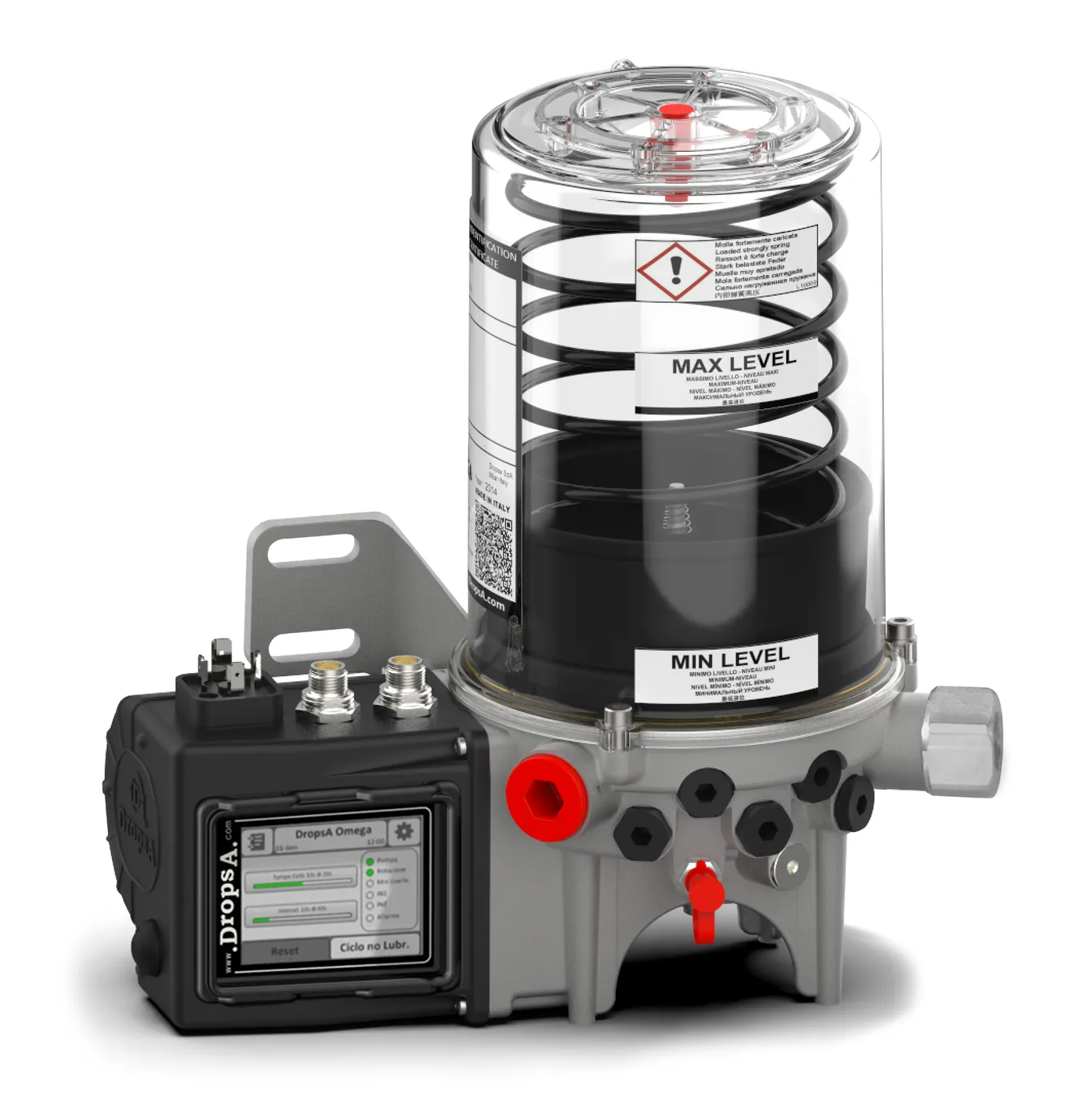
Pump OMEGA AUTOMATICA
Control of lubrication cycles via touchscreen display
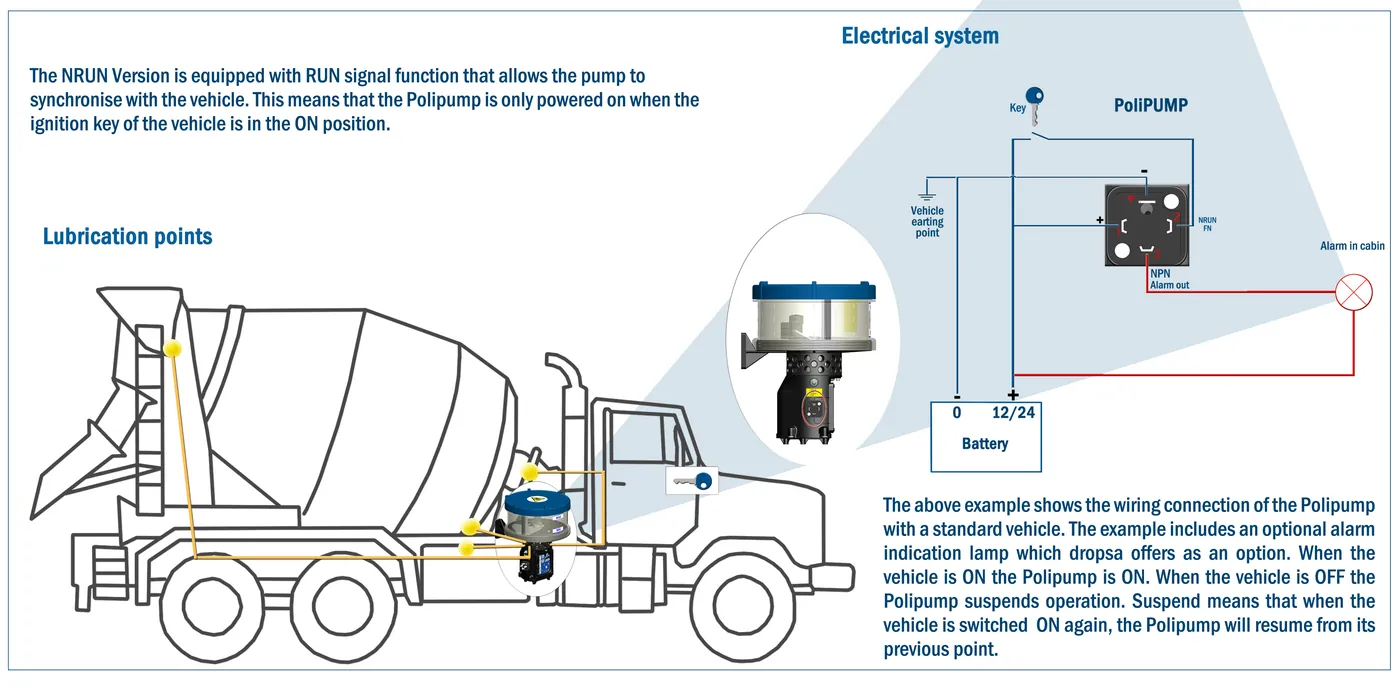
PoliPUMP NRUN
For the automotive industry with NRUN approval
Technology
Technical data and selection
The electric pumps on this page share something that sets them apart from the other ranges: they all run on 12 or 24 V DC. These are not shop-floor units on a three-phase supply but grease pumps for vehicles, construction and agricultural machinery — fed from the on-board network, built for vibration, cold and tight spaces.
| Model | Outlets | Max. pressure | Reservoir | Lubricant | Temperature |
|---|---|---|---|---|---|
| PoliPUMP FP | 12 · 24 · 35 | 80 bar | 0.5 l · 4 l | NLGI 00–2 | −10…+60 °C |
| PoliPUMP NRUN | 12 · 24 · 35 | 80 bar | 0.5 · 2 · 4 l | NLGI 00–2 | −10…+60 °C |
| FEMTO | 8 · 2 | 200 bar / 280 bar | 1 · 2 · 4 kg | NLGI 000–2 | −40…+60 °C |
| OMEGA / OMEGA AUTOMATICA | 10 | 200 bar / 280 bar | 1.2 l | NLGI 000–2 | −20…+70 °C |
Source: DropsA manufacturer data, retrieved 31 July 2026 – PoliPUMP FP · PoliPUMP NRUN · FEMTO · OMEGA. The figures in the respective datasheet are binding.
All four run on 12 V DC or 24 V DC.
Pressure separates the ranges, not size
The most striking difference in the table is 80 bar for the PoliPUMP against 200 to 280 bar for FEMTO and OMEGA. That is not a quality gap but a system decision: the PoliPUMP feeds its lubrication points directly, without external metering valves and without cycle sensors — 80 bar is enough for that. FEMTO and OMEGA also feed progressive dividers, and a progressive system builds whatever pressure it needs to index.
Hence the selection rule: once the system type is fixed, the pump is largely determined. For simple direct supply the PoliPUMP is cheaper and faster to install; as soon as progressive dividers are involved, only the ranges from 200 bar upwards qualify.
FEMTO: −40 °C is the outlier
The FEMTO is the only pump on this page DropsA rates down to −40 °C — 30 kelvin below the PoliPUMP and 20 below the OMEGA. For machines that start outdoors in winter that is the deciding criterion, not flow rate.
It also offers the finest metering: the ten pumping elements are available at 0.005, 0.01, 0.015, 0.025 and 0.05 cm³ per cycle in the Multiline version and 0.14 and 0.26 cm³ in the Basic version. The volume per point is therefore set by the pumping element itself, not by a downstream metering valve. The housing is plastic, with a stirring paddle or follower plate and a minimum-level sensor.
Stirring paddle or follower plate — and why NLGI matters here
Grease does not flow back to the inlet on its own. A stirring paddle keeps it moving, a follower plate pushes it down. The stiffer the grease, the more this matters: at NLGI 2 a pump without either will hollow out a cavity and draw air, whereas NLGI 00 still flows by itself. All four cover up to NLGI 2, FEMTO and OMEGA additionally down to NLGI 000. What the classes mean is explained in our article on NLGI classes.
Looking for the right product?
We support you with selection, design and quotation – oil & grease, for every application.
Knowledge
Further content
- Hand pumps – manual lubrication
- Hydraulic pumps – high performance
- Progressive distributor – uniform distribution
- Dual-line systems – long distances & high viscosity
- Cycle sensors – monitoring lubrication cycles
- MAGNOM® filter – particle & magnetite separation
- Industrial oils – selection & application
- Troubleshooting the ZSA – checklist
- Central lubrication – basics & planning
- Contact & Offer – Individual advice