Range
Products at a glance4
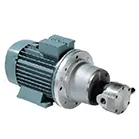
GPU3 pump
Gear pump with a flow rate of 6 to 17 liters, designed for base mounting
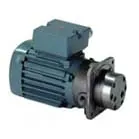
GPU2 pump
Gear pumps up to 3 liters for base plate mounting
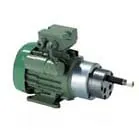
GPU1 pump
Gear pump with up to 3 liter displacement for base mounting
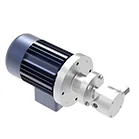
Motor driven gear pumps
For lubrication, cooling, hydraulics and circulation of liquids in machines
Technology
Technical data and selection
A gear pump delivers oil continuously and almost without pulsation. Two meshing gears trap a fixed volume in every tooth gap and carry it from the suction to the pressure side. Flow therefore follows from speed and displacement and only weakly from back pressure — exactly the behaviour circulating and cooling lubrication needs, where a steady oil volume matters more than high pressure.
| Model | Flow | Working pressure | Viscosity | Temperature | Protection |
|---|---|---|---|---|---|
| GPU1 | 0.06–3 l/min | 35 bar | 20–750 mm²/s | 0–80 °C | IP 44 |
| GPU2 | 0.06–3 l/min | 35 bar | 20–750 mm²/s | 0–80 °C | IP 44 |
| GPU3 | 6.0–17.0 l/min | 35 bar | 20–750 mm²/s | 0–80 °C | IP 44 |
| Motor-driven gear pumps (Series 122000) | 250 cm³/min | 100 bar valve set to 90 bar | 15–1000 cSt | – | IP 55 |
Source: DropsA manufacturer data, retrieved 31 July 2026 – Datenblatt C2347PG · Datenblatt C2348PG · Datenblatt C2349PG · Serie 122000. The figures in the respective datasheet are binding.
The GPU range ships in fixed sizes, not continuously variable. DropsA lists eleven flow rates for the GPU1 from 0.06 to 3 l/min with motor ratings of 0.18 to 0.55 kW; the suction port changes from G 1/4 (up to 1 l/min) to G 3/8 (from 1.2 l/min), while the delivery port stays G 1/4.
What these figures mean for system design
The GPU range and the motor-driven Series 122000 solve two different problems, and the pressure says so: 35 bar against 100 bar. The GPU circulates oil — plenty of volume, little pressure. The Series 122000 delivers only 250 cm³/min but up to 100 bar, and carries a relief valve set to 90 bar. What counts is always the figure the pump may run continuously, never its maximum.
The viscosity window is the second figure that gets skipped. 20 to 750 mm²/s sounds generous, but it applies at operating temperature — not at a cold start. An ISO VG 320 sits mid-window at 40 °C and far above it when an unheated hall starts up in winter. How viscosity grades and consistency ratings relate is covered in our article on NLGI classes.
Selection in four steps
- Add up the oil volume per lubrication point and derive the required flow from it — not the other way round
- Estimate system pressure at operating temperature and check it against the continuous rating, not the maximum
- Check viscosity at the lowest start-up temperature, not at 40 °C
- Weigh mounting location and wash-down routine against the protection grade — IP 44 resists splashing, IP 55 adds dust tightness and jet water
Looking for the right product?
We support you with selection, design and quotation – oil & grease, for every application.
Knowledge
Further content
- Progressive distributor – uniform distribution
- Dual-line systems – long distances & high viscosity
- Cycle sensors – monitoring lubrication cycles
- MAGNOM® filter – particle & magnetite separation
- Industrial oils – selection & application
- Troubleshooting the ZSA – checklist
- Central lubrication – basics & planning
- Contact & Offer – Individual advice