Range
Products at a glance3
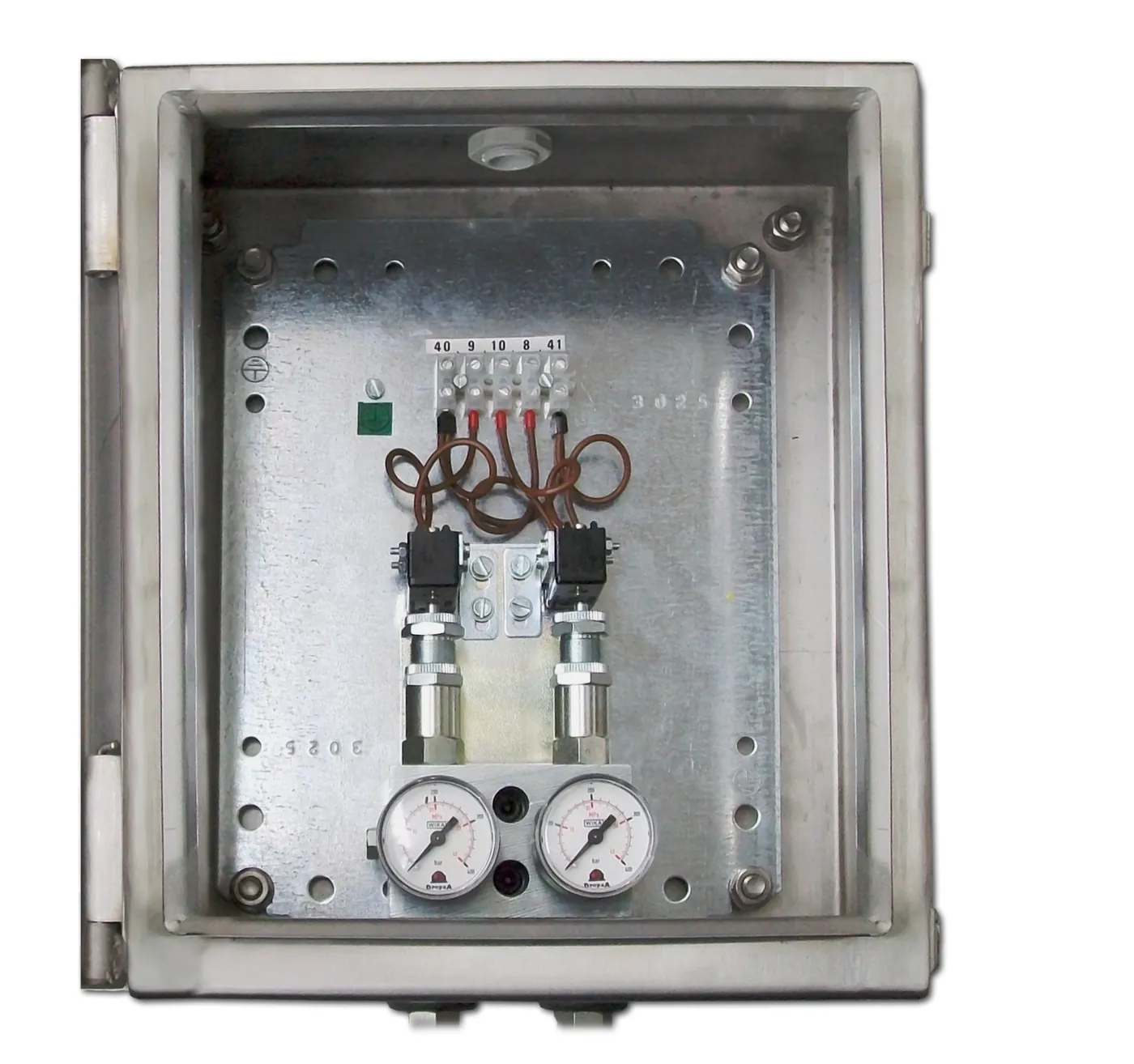
Stainless steel two-line final pressure switching device
Compact stainless steel housing, suitable for two supply lines. Switches reliably when the final pressure is reached in small and medium-sized lubrication systems.

Membrane pressure switch
Sensitive membrane mechanism for precise pressure switching. Ideal for applications with subtle pressure changes and low hysteresis.

Piston pressure switch
Robust piston mechanism for high pressures. Provides stable switching signals even under fluctuating operating conditions.
Pressure control unit
Adjustable from 4.5 to 40 bar, changeover contact 15 A at 220 V AC. Switching differential 5 bar, protection class IP 54.
Technology
Technical data and selection
The pressure switch is the component that lifts a lubrication system from “running” to “working”. It reports whether the intended system pressure was reached — and with it, indirectly, whether the line is tight, the divider free and the medium deliverable. The designs differ considerably, and the choice almost always comes down to permitted pressure and contact rating.
| Type | Pressure | Contact | Temperature | Protection | Connection |
|---|---|---|---|---|---|
| Diaphragm pressure switch | max. 300 bar permitted | max. 42 V, 100 VA | −30…+120 °C | IP 54 | M10×1 |
| Pressure control unit | range 4.5–40 bar max. 100 bar | changeover 15 A/220 V AC 0.25 A/250 V DC | −20…+70 °C | IP 54 | 1/8″ BSP |
| Piston pressure switch | adjustable 20–300 bar max. 200 bar working | 5 A/220 V AC 0.2 A/220 V DC | – | IP 55 | 1/8″ BSP |
| Piston, changeover version | up to 240 bar | changeover 10 A/110 V AC 0.6 A/110 V DC | −20…+70 °C | IP 54 | 5/16-24 NF |
| Piston, NO/NC | max. 60 bar | – | 0…+80 °C | IP 65 | 20–750 mm²/s, NLGI 000 |
| Dual-line end-of-line switch, stainless | 30–330 bar | 250 V AC, 15 A 10⁶ operations | −10…+85 °C | – | 2 × 1/4″ BSP |
Source: DropsA manufacturer data, retrieved 31 July 2026 – Membran-Druckschalter · Kolben-Druckschalter · Enddruckschaltgerät INOX. The figures in the respective datasheet are binding.
Temperature separates the designs more sharply than pressure
What stands out in the table is the diaphragm switch at −30 to +120 °C. That is a far wider window than any other version and the reason this design is used on hot units and outdoors. It is paid for with a low contact rating: 42 V and 100 VA are enough for a PLC input signal, not for switching a contactor directly.
Conversely the pressure control unit switches 15 A at 220 V AC through a changeover contact and can be wired straight into a controller. Its differential of 5 bar is the figure that counts when sizing: the switch only drops out 5 bar below the pick-up point. That prevents chattering during pressure build-up, but also means pick-up and drop-out cannot be chosen independently.
Permitted pressure is not working pressure
The piston switch lists two figures side by side: an adjustment range to 300 bar and a maximum working pressure of 200 bar. That is not a contradiction but the usual split between what the device withstands and what it may see continuously. Sizing always goes against the second figure.
The IP 65 version is the only one that names a medium: 20 to 750 mm²/s, or NLGI 000. It is therefore explicitly intended for oil and fluid grease, not for an NLGI 2 grease. Why the consistency class is a hard limit here rather than a recommendation is covered in our article on NLGI classes.
The end-of-line switch is a special case
It does not sit at a lubrication point but at the end of a dual-line system, and it is not a single switch but an assembly: two microswitches, two pressure-setting valves, two gauges and two bleed valves in a stainless housing (part number 1124459).
Its job follows from the system type. A dual-line system changes over when the target pressure is reached at the end of the line — only then is it proven that every divider in between has worked. If pressure falls below the set value the unit raises an alarm or blocks the machine. At 30 to 330 bar it covers the usual dual-line range; the stainless version is meant for wet areas. On the system type see dual-line systems.
Looking for the right product?
We support you with selection, design and quotation – oil & grease, for every application.
Knowledge