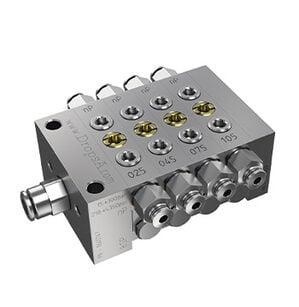
Progressive lubrication explained: structure, advantages, limitations and typical applications
Progressive lubrication is one of the most important types of automatic lubrication systems. It is particularly strong when a compact, traceable and easily monitorable lubrication network is required.
In-depth on the topic: Functional principle of central lubrication and Single-line lubrication practical applications explained in brief. These contributions complement the system decision in practice.
What progressive lubrication means in practice
The core of progressive lubrication lies not just in a distributor block, but in clear system logic. Lubricant is distributed in a defined sequence, making functional control and diagnosis easier in many applications than with fuzzy networks.
It is precisely this traceability that makes the system attractive for many machines, systems and mobile applications. In practice, this creates lubrication that is not only automatic, but also easier to observe and maintain in a more structured manner.
Where the system is particularly strong
Progressive lubrication is particularly suitable for compact to medium-sized networks with a clear lubrication point structure. In production plants, packaging machines, construction machines and commercial vehicles, it is often closer to the real task than large industrial systems.
The combination of grease pump, distribution logic and sensors creates a good middle ground between robustness and transparency. This is precisely why progressive lubrication is chosen in many retrofit projects as an economical introduction to automatic lubrication.
- Clearly defined distribution sequence
- Good diagnostic ability in operation
- Very suitable for compact to medium-sized networks
Limits and typical misunderstandings
Despite its strength, progressive lubrication is not automatically the best answer to every lubrication network. If line routes become very long or the number of lubrication points increases significantly, dual-line lubrication may be more systemically suitable. A common mistake is to prefer progressive just because of the term's familiarity.
Equally problematic is the assumption that the distributor alone determines the system quality. In practice, the pump, medium, cable routing and diagnostic integration are at least as relevant as the distribution block itself.
What procurement and maintenance should know
Anyone purchasing progressive lubrication should first understand the network diagram: How many lubrication points are there, how far apart are they, what medium is used and how important is a quick diagnosis in the event of malfunctions. These questions determine whether the system is technically and economically suitable.
For maintenance, it is crucial that the distribution sequence is not only understood but also documented. Only then can deviations, blockages or refill problems be quickly identified and properly resolved in everyday life.
Practical recommendation for German projects
In Germany, progressive lubrication is particularly strong when system availability, clear maintenance logic and planned retrofitting come together. This creates a very viable path between technology and ROI, especially in medium-sized machine parks or mobile applications.
However, the best decision does not come from the keyword itself, but from the comparison with dual-line, single-line and manual lubrication. Only this comparison makes it clear when progressive lubrication is really the economically best answer.
← Back to the blog