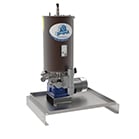
Selecting a grease pump: What really matters in industry, construction machinery and trucks
In practice, selecting a grease pump is not a catalog question, but rather a system decision. The decisive factors are the medium, pressure requirement, pipe network, operating environment and the question of how stable the lubrication has to function in everyday life.
In-depth on the topic: more about oil pump design and more about choosing a system: grease or oil decision-making aid. These contributions complement the system decision in practice.
Why the grease pump is often compared incorrectly
Many inquiries start with a type designation or with the assumption that any grease pump can solve any task given sufficient pressure. In reality, it is precisely this simplification that leads to later problems. A grease pump is not used in isolation, but as part of a central lubrication system with distributors, lines, sensors and a defined filling process.
Reproducibility is particularly crucial in production plants. In construction machinery, on the other hand, what matters is whether the pump works stably despite dirt, shocks and irregular operating times. In the truck sector, the focus is on standardization and clear maintenance windows. Therefore, the selection must always be made based on the real application and not on the brochure image.
Technical selection criteria
The first selection criterion is the medium. Grease consistency, temperature behavior and pumpability in the pipe network directly determine which grease pump makes sense. A second point is the pressure requirement. Long lines, many lubrication points or narrow distribution structures require different reserves than a compact retrofit system on a single machine.
Equally important are container size, refill routine and level monitoring. A technically suitable grease pump immediately loses value if the filling concept is not implemented properly in everyday life. In industrial systems, the question of how the pump is connected to the control and fault signaling concept is also important.
- Determine medium and NLGI class before pump selection
- Document line lengths and number of lubrication points
- Think about filling, sensors and spare parts right from the start
Typical errors in real projects
A common mistake is transferring an existing pump solution to a modified machine, even though the pipe network, distributor or medium are no longer identical. Another mistake is to focus purely on the pump, while blockages, unfavorable pipe routes or unclear refill processes are not taken into account.
In the mobile sector, the extent to which vibration, dirt and mechanical influences influence the stability of the lubrication is often underestimated. In the stationary area, on the other hand, malfunctions are often noticed too late if no proper level or function monitoring is provided.
How the selection becomes commercially sound
Procurement and maintenance should be able to answer the same questions: Which lubrication points are critical, how expensive is unplanned downtime and how well can maintenance be standardized. Only when these points are clear does the product inquiry become a reliable investment decision.
A good grease pump not only reduces manual lubrication work. It helps to stabilize lubrication quality, reduce wear at heavily loaded points and make service windows easier to plan. This is precisely why the combination of a grease pump, progressive lubrication and a suitable spare parts concept is economically stronger in many projects than a pure individual component.
Recommendation for practice
When selecting a grease pump, you should first describe the medium, lubrication points, operating environment and network structure. This is followed by the selection of pump, distribution principle and monitoring. This creates a clear path from the clarification of needs through the technical examination to the specific inquiry.
This structured process is particularly important for Germany because many projects arise from retrofit situations. There is a great temptation to just replace the obvious unit. In practice, it is often more economical to modernize system logic and maintenance routines at the same time.
← Back to the blog